Chapter 9
The Parent My Child Imagined
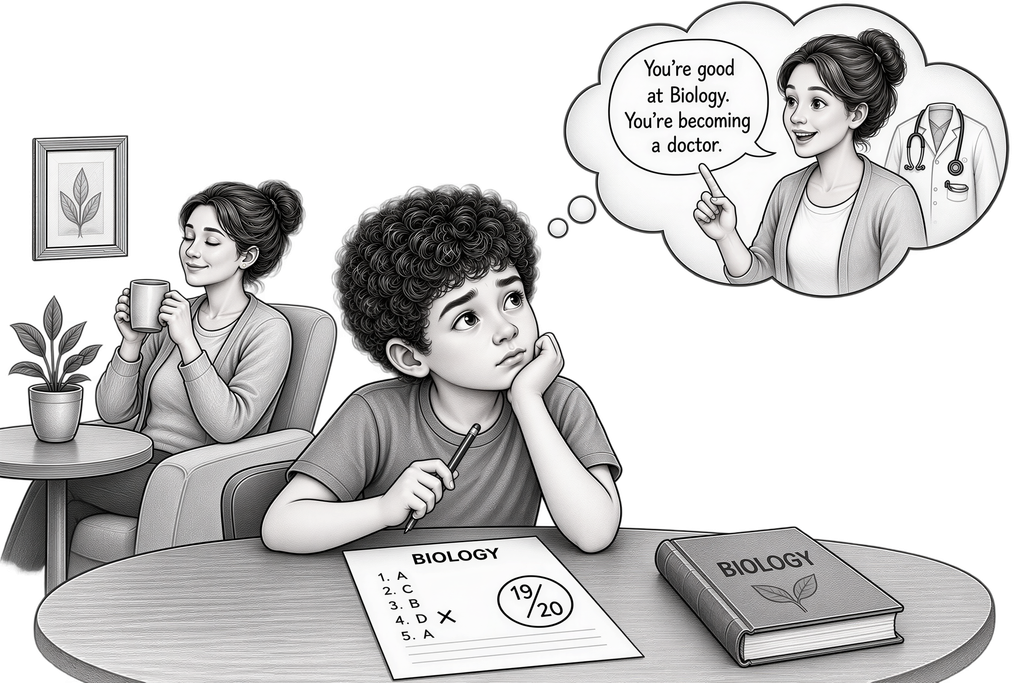
“Mom, I deliberately got one answer wrong.”
I looked up from my morning tea, wondering if I had heard him correctly.
“You did what?”
“I got one mark less in Biology on purpose.”
I waited for an explanation that made sense.
“Why would anyone deliberately lose a mark?”
His answer caught me completely off guard.
“Because if I get full marks in Biology, you’ll make me become a doctor.”
For a few seconds, I simply stared at him.
Then I laughed.
Not because it was funny, but because it was so unexpected.
“Where did you get that idea?” I asked.
He shrugged.
“I just know.”
The strange part was that I couldn’t remember a single conversation in which I had ever suggested that he should become a doctor.
In fact, I had consciously avoided doing exactly that.
I had never insisted on perfect marks.
I had never told him that one subject determined his future.
If anything, I had always believed children should discover their own interests.
So where had this fear come from?
The more I thought about it, the more I realised that this wasn’t really about Biology.
It wasn’t even about doctors.
It was about the invisible stories children quietly create.
As parents, we often believe our influence lies in the words we speak.
We tell ourselves, “I never said that.”
“I never pressured him.”
“I never expected that.”
Children don’t grow up just listening to our sentences but interpreting our silences too.
They notice the relatives who praise the cousin studying medicine.
Teachers, movies, friends, and everyday comments all become clues.
They notice which professions society celebrates and which ones it quietly dismisses.
Piece by piece, they construct a picture of how the world works.
Sometimes, they also construct a picture of us.
Not the parents we actually are.
The parents they imagine us to be.
Somewhere along the way, my son had built a version of me who would proudly announce, “You’re good at Biology. You’re becoming a doctor.”
That mother existed only in his imagination.
Yet his decisions were being shaped by her.
It made me wonder how many other invisible stories our children carry.
The child who refuses to try may not be afraid of failure.
Maybe he believes failure will disappoint parents who have never actually said so.
The girl who hides her paintings may not be afraid of criticism.
Maybe she has convinced herself that art isn’t a “real career.”
Children are extraordinary storytellers.
The only problem is that they rarely tell us the stories they are writing.
They simply begin living them.
As adults, we do something remarkably similar.
We assume what our boss thinks of us.
We imagine why a friend didn’t call.
We decide what others expect from us without ever asking.
Human beings don’t just live in reality.
We live in the stories we create about reality.
Children are no different.
Only their stories are written with far less evidence and far more imagination.
That conversation taught me something I hadn’t expected.
Parenting is not only about choosing our words carefully.
It is also about discovering the conversations our children are having inside their own heads.
Because those silent conversations often shape them far more than the spoken ones.
That evening, I told my son something I wish I had said much earlier.
“You know,” I said, “you never have to change your choices because of what you think I want.”
He looked at me.
“What does it mean?”
“I want you to discover what you want.”
Perhaps that is the real challenge of parenting.
Not making our children fit the dreams we have for them.
But gently helping them rewrite the stories they have unknowingly written about us.
Because one day I realised something both humbling and beautiful.
I wasn’t just raising my son.
All these years, he had been quietly creating a parent inside his own mind.
Every child carries two parents—one who exists in reality, and one they have constructed in their imagination.
Perhaps parenting is not only about becoming the parent we hope to be. It is also about discovering—and gently correcting—the parent our child imagines us to be.